



Amy B Cross – the workaholic, vegetarian, poultry farmer
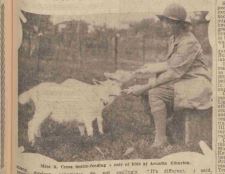
May I introduce you to Miss Amy B Cross. ‘Who?’ I hear you say. Read on.
I discovered Amy whilst trawling through the newspapers online looking for articles relating to the history of Elburton, a village on the eastern edge of Plymouth. I kept seeing her name pop up, then in ‘Ann’s Deputy’s Corner’ in the Western Morning News and Daily Gazette on 25th August 1939, I came across an interview with her. She was quite a character, and by using some other sources, I’m gradually piecing together her life.
Miss Amy Blewett Cross was born on the 17 September 1882. At the time of her baptism (15 June 1897) in St Paul’s Church, East Stonehouse she was living with her parents at 56 Durnford Street – her father Daniel was an Army and Navy Contractor, and formerly a master tailor in the Royal Marines.
Like many young women, Amy was expected to marry and have a family – but she didn’t want that. She wanted a career. She eventually persuaded her parents to let her follow her own path, and began studying as a gardener at Studley Agricultural College in Warwickshire. Whilst there, she met a fellow student called Dorothy Smith who was taking a course in poultry farming “We became friendly, and thought it would be a bright idea if we could combine our knowledge and start a market garden and poultry farm together”. Amy and Dorothy chose Cleveland at Bere Alston for their new venture, and by 1911 were up and running. They employed Minnie and Henry Leech as domestic servant and garden boy respectively. They were 14 and 15 years old.
Amy recalled how the villagers were “very doubtful and suspicious of us”. Some thought them “daring hussies” and others doubted their sanity. Some asked them if they really did dig. She commented on how odd characters and vagrants would appear in the lanes “As it was not always convenient to take our profits to the bank we had to keep them in the house. So I made it a custom to sleep with a loaded revolver under my pillow”.
With the coming of war in 1914 their workload increased and Amy and Dorothy were unable to cope with it. But not for long. They were asked to help organise the first Women’s Land Army which, according to Amy, was even harder work “but all the same we loved it.” There were challenges however. Many of the young women were afraid of being called ‘brazen’ because of the manual nature of the work, and many of the farmers were unwilling to take them. She regularly begged the local “yeomen” to take the girls to release the men for war work “ ‘No’ they said, if we have to release all our men we’ll close down rather than employ those girls”. She recalled that when the men were demobbed in 1920 “they shook their heads regretfully and a wee bit sheepishly. For good reason too,” she chuckled, “they didn’t want to lose the girls then.”
Amy left the Women’s Land Army in 1920 as a welfare officer, but carried on with welfare work in Bristol for a time. However the call of the land was too much and in 1921 she bought a small farm at Elburton in Plymstock, nr Plymouth. Her intention was to run the farm as a market garden, but one of her brothers sent her six chickens as a result of having too many hatch out, so her plans ultimately changed. She kept the chickens and by the time of the interview, she had 800. She also had “an enchanting little dusky grey kitten full of joie de vivre” who she presumably named after her dear friend Dorothy.
Amy lived at 8 Arcadia and ran her poultry farm in the field known as Clampits (sometimes spelt Clampitts). After checking the tithe map and apportionment, this appears to be on the other side of the road and is now two separate paddocks. The buildings on the lower paddock appear to be the same ones as those used by Amy, as suggested by looking at the Ordnance Survey maps. Not only did she run a fair-sized poultry farm, she also kept goats (to supply milk and cream) and bees. She was certainly a busy woman. In her interview when asked about holidays . “Holidays, holidays, what are they?” she asked laughingly. “I haven’t had one for 27 years”. She regularly worked 18 hours a day and 7 days a week “Animals do not lose their appetites because it’s Sunday, and so they have to be fed.” She also commented that most of her employees had been female. Having said that, at the time of the interview, she was employing two German refugees, George and Elizabeth Rosenberg (changed to Rost, he was formerly a grain merchant) and on inspection of the 1939 Register, she is employing three males under the age of sixteen. Judging by a letter she wrote to the same newspaper in 1942 ‘Forgive the Germans’ she was a deeply religious woman too.
Another thing she was very proud of, was that she was never ill “I’m waiting for a cold to see what it feels like”. Amy attributed her health to her outdoor way of live. She was a vegetarian, a teetotaller and never smoked. The majority of her diet consisted of eggs, cream, cheese, goats’ milk and plenty of “green stuffs”, but she was not rigid “Eat what you like without being a nuisance to others with your diet” was her slogan. The interviewer noted that Amy was the happiest person she had ever met.
Amy didn’t marry until early in 1949, her new beau being somewhat younger than her by 39 years. Arthur John Worth Paddon was born in 1921, so was only 28 years old compared to Amy’s 66. His second wife was also considerably older than him!
Amy and Arthur moved to Moretonhampstead, in Devon, living at 25 Court Street where they ran a kennel. The property was later renamed Kennel Cottage which it stills retains today. Amy died in 1957 aged 75.
So there you have it. A potted history of the life of Amy B Cross. There is a lot more I could have written and there is a lot more still to find about this fascinating and independent woman. I’m looking forward to Covid being ‘kicked into touch’ to discover more.