


Edrica De La Pole – the Devon lady farmer.
An archive ‘deep-dive’.
I recently posted on my social media channels about Edrica and have become fascinated by her. The following information is my delving to date.
She was born Edrica Blanche Pole on 26 November 1855, and baptised at St James’ in Paddington, London, on the 25 March 1856. Her parents were William Edmund and Margaret Victoriosa Pole. William married Margaret (nee Talbot) in Uplyme, Devon, on 26 April 1841. Margaret’s father was Vice Admiral John Talbot who had an interesting career – on entering the Royal Navy in 1784 he joined Horatio Nelson’s ship HMS Boreas.
Edrica’s father was a barrister and in 1851 the family were living in Paddington. There is a great example of not relying on everything you see in the census here. Margaret was mistakenly entered as Marianne (also of Devon), but having checked, William and Margaret were together until she died in 1886. By this point, the couple had three children – Jane, Edmund and Frederick. By 1861, they had added Emily, Arthur and Edrica and were living in Guildford, Surrey. Edrica had two other sisters born prior to her birth who both died young, Julia Margaret (aged 3) and Georgina (an infant).
By 1871, the family had moved to Streatham and living in a property called Colcombe. I suspect the house was given this name because Colcombe Castle was near Shute Barton (the family seat) and Sir William Pole (William Edmund’s ancestor) lived in the castle from 1618. Edrica also now had a sister called Geraldine. William and Margaret had Edrica and Geraldine later in life as they are shown as being in their 50s when the two girls were 11 and 13.
Sometime after the death of Margaret in 1886, William retired and moved to the family seat of Shute Barton in Colyton, Devon, with his two youngest daughters Edrica and Geraldine. Edrica had already developed an interest in animals and farming. At Shute, she was given a small plot in the gardens to utilise as a “farm”. From at least 1880, she was entering dogs (particularly deerhunters) into shows and winning prizes. She also registered a Patent in 1891 with John Henry Boll of Yeovil for “Improvements in shafts for road vehicles”. From her diaries (see below) she also appears to be quite a horsewoman.
When Edrica’s father died in 1895, she moved to Hawkchurch in Devon, and then to Wastor Farm in Kingston, where she had a house “Tremar” built for her and her sister Geraldine (although the latter may not have lived there as she doesn’t appear on any census as being at Kingston). Edrica appears to have been very independent and self-sufficient, employing local help as required. On the 1901-1921 censuses, she is living alone at “Tremar” and is now calling herself ‘De La Pole’[1]. On the 1939 register, there does appear to be someone else living with her, but the entry has been redacted due to the 100 year restriction on access.
I have transcribed some short pieces from her 1915 diary which show her independent spirit and daily routines, as well as giving the names of some of the local people:
January 1
I brought all my carriage harness in and put it to dry in the hall. I made an excellent pie of minced cold beef with a suet crust and I roasted my knuckle of mutton. I am afraid it was frosted for the fire was brisk and I kept the meat over two hours in the oven but it came out purple. I also cooked several Beet and Parsnips.
January 3
Got up early and had a lovely tub. Fed my horses and myself and went to church but being too early went in to Mary Freeman’s and had a yarn. Much amused to find her boy there whom I could not persuade to enlist. He is trying for the police. It seems that when he told his mother off my effort she expressed a wish to “see the lady” so I told her she could have a shy at me now if she pleased but nothing came of it. Mrs Pitman overtook me coming home. Says about 200 men are reported to have been saved from the ship that was torpedoed off Start Point.
January 5
I devoted the very wet morning to cleaning up my road which is flooded. Cut two little grips and chopped off the turf where it encroached. Set in a fine afternoon Omar hammered for a run. Turned them all out and cleaned the boxes. I am using sea sand for the bedding but though it prevents the dung caking on the horses coats it is heavy to handle and soon becomes mud. Brought the handcart to the work shop to repair it but it is pretty far gone now. Has lasted nearly 2 years.
January 7
Another terribly rough day. I can’t get the air of the house to feel the least bit dry the rain comes in so incessantly both from doors and windows. Each ?map pil? holds a pailful and has to be shovelled out every morning. Chopped up a lot of sticks and lighted the big range. Boiled out some kitchen cloths but could not use the scullery.
January 12
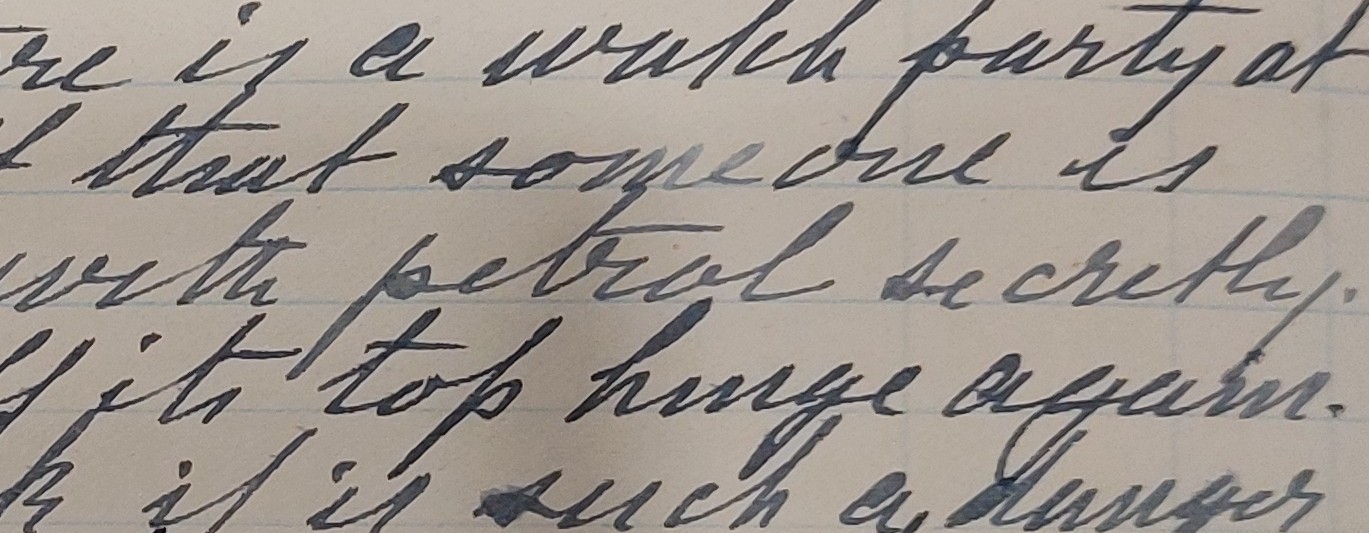
P H M sends me F’s cheque for all my expences. Put Omar in the dogcart and loaded up the wool. Met Mrs Miles exercising her two kids on Prigden Hill. Told her how to find the door key of she liked to have a rest at my house. She must have met her husband soon for I did not see her again. Pony went very well considering how heavy the roads are. Just as I was feeding round Freeman came with a load of sand. Says there is a watch party at Mothecombe as it is felt that’s someone is supplying the Germans with petrol secretly. The hay house door came off its top hinge again. I must divide it half heck it is such a danger and nuisance. Propped the door on barrows and cut it across then set up the lower half nailing a piece of wood across the top as I had no hinge ready. Had to climb in and out to get the hay at suppering time.
January 22
Baker forgot all about my brown loaf and never brought my collar from Ford. I offered Woods 2/6 to help cut out hay today! He promised to come and of course never turned up. I worked hard and got in enough to last up to Sunday. Miss Heynes sent me some cheese so I made a good midday meal and then brought in faggot wood. I have to work pretty hard and seldom get the chance of a ride or drive unless I let everything else go undone.
December 25
John Triggs was my Christmas Card bringing me 3 pocket broccoli. I have him some cider while he skinned my rabbits. One was “blistered” so had to be discarded. I let him take it to boil down for his fowls. He exclaimed at the sight of my wood blocks but agreed to put it in a day with me at Babland/Bubland cross cutting the rest. Then we cleared the boxes while the horses were out. They raced a good deal all of them. I got the Hall fire going nicely today and sat over it enjoying books and papers. Fowl ate very good.
By 1941, Edrica’s handwriting had worsened, possibly due to arthritis (she was 86). Her entry for June 27 seems a little confused and the spelling erratic:
Mote vexatious. PHM has not heard from the War ?Age[n]t ??? and asks 20 questions on my letter to him. I had got up extra early and was busy turning out my bedroom when there was a knock on that door. I found Mr Jackson had come to ask for my hay mower. I was not able to let him have it, he wants to cut tomorrow. Left my job to make a plan of my land to send to London. The flies had been at my pork, therefore the cats had to eat it. Got my room half done, the stairs brushed my face washed and a bath towel done also. Made coffee for midday. Sent my letter by the baker but he did not bring me the 9d from Small. Mr Jackson sayd seeds of many sorts have failed the season has been so backward. Dunkin still at his mangel. He began on the 10th. They are costing him something!
Edrica didn’t marry and doesn’t appear to have had any children. She died on 11 February 1947 aged 92. According to the memories of Sheila who moved into “Tremar” when she was 8 years old (c1958 - many thanks to the local history group in Kingston) Edrica was known locally as ‘the Old Lady’ or ‘Miss De La Pole’ and was an eccentric. Extracts from Sheila’s description of the house and Edrica is worth recalling here:
"My first sight of Tremar was on my 8th birthday, a rain sodden day in the Easter Holidays. This large miserable looking house loomed up through the rain at the end of a puddle filled drive. Another family were on their way out, “It’s dreadful”, said the father……I cannot really remember much of that viewing but I can recall there was a lot of house, full of dirt and cobwebs, not surprising as we discovered it had been empty since “The Old Lady” had been found dead at the foot of the stairs ten years before……..The pink granite walls were very thick, supposedly to keep the house warm, but I remember it being very cold in winter…….Our farmer neighbour was always happy to relate stories of Miss De La Pole’s eccentricities……..He would regale us with tales of how she would bathe in a bran filled hip bath in the tack room with the door open so she call him in to chat. He also said that when her gardener annoyed her she made him plant the entire lower field with cabbages, roots up, before making him replant them correctly…….."
Edrica died at the foot of her stairs holding a candle. Sheila discovered candle wax on the bottom step shortly after she and her family moved into the house.
Edrica didn’t leave a will and died intestate. There was a notice in the paper after her death asking if anyone knew of the whereabouts of her will. She left £12,759 6s 7d. Letters of administration were proved on 14th June 1954 in London with everything being left to her sister Geraldine who was at the time incapacitated and of unsound mind (Geraldine died at the age of 98). It seemed to be a family trait. Edrica’s father also died intestate in 1895. His son Sir Edmund Reginald Talbot De La Pole handled his father’s affairs.
Edrica’s diaries I know will tell me so much more about her life and her character. There is one for virtually every year from 1883 (a gap 1935-May 1941), plus account books and plans of the house “Tremar”. There is also an interesting scrapbook of sketches and cartoons compiled by William Pole – some appear to have been done by his children. There is a drawing signed ‘M V Pole’ and dated 1850 (Edrica’s mother?). At the back is a beautiful drawing of a young woman. Could this be Edrica’s mother Margaret? I look forward to discovering more about this fascinating female.
(I think Edrica was using the ‘De La’ as an addition to her surname after her father assumed the baronetcy in 1874, following the death of his half-brother, Sir John George Reeve-De La Pole in 1874. The Pole family of Shute assumed the prefix ‘De La’ by Royal License in 1790 as noted in the Illustrated London News).
(Copyright for this post lies with Deborah Lister).
('Sneaky peek' - The Box, Plymouth Archives, acc. 1306).