



Plymouth Castle and Castle Street
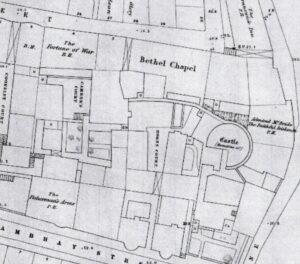
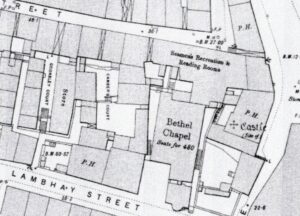
This is not a history of Plymouth Castle but a signpost to a handful of local documents and information for anyone wishing to undertake the task and build on the current research (of which there is plenty). The documents listed are held in The Box, Plymouth Archives and can be accessed by making an appointment in the Cottonian Research Room and quoting the reference numbers below. Further research into deeds for other properties on the Barbican may result in other vital clues.
The Barbican is a fascinating area and I dread to think what archaeology lurked beneath the centuries of rebuilding and development and may well have been destroyed forever. The castle which was demolished to make way for the Citadel (begun in 1665) is always an interesting structure to research. C W Bracken in a lecture referred to in the Western Morning News on 15 December 1927 stated that ‘A portion of the one of the outer towers was still left today......and to see it they had to go along the Barbican, up the lane towards Phoenix Wharf, and on their right was a small cliff, on top of which stood the old castle. The portion of the tower at present was the property of the Seamen’s Bethel proprietors, and he hoped it would not be destroyed’. It is now widely considered that the structure that Bracken was alluding to is not part of the castle remains. As you can see from the two town plans above dated 1855 and 1893, the remaining tower ruin was destroyed when the Bethel extended its premises in the latter part of the 19th century. It’s a pity that there doesn’t appear to be a surviving photograph of the site. I hope the following will spurn someone on to further research into this apparently vanished iconic Plymouth fortification:
Ref. 1/485/18, Plymouth Borough records: A lease for 99 years between the Mayor and Commonalty of Plymouth and Thomas Yeabsley of Plymouth, merchant. Lyme Kylles, Lyme House and new erected messuage or tenement and garden lately enclosed with appurtenances near the Castle, and all those two messuages or tenements near the Barbican, bounded with the Barbican on the east part, by the Lyme Kylles [lime kilns] on the south part, by the Castle wall on the west part, and a way leading from the Barbican to New Street on the north part. Consideration: £130. Rent: 20s pa. Date: 3 Dec 1661
Ref. 1/485/16/2, Plymouth Borough records. A lease for 10 years between the Mayor and Commonalty of Plymouth and George Burrard of Plymouth, merchant. Piece of waste ground near the Barbican, Plymouth, adjoining the South Key, upon which said piece of waste ground was lately erected a beer cellar and several shops, bounded by Castle Street on the west, a street leading from the Barbican to New Street on the south, and the South Quay on the east and north. Consideration: £20. Rent: 10s pa. Date: 29 Sep 1649
Ref. 1/133, Plymouth Borough Receiver’s account book ‘north east part of the castle lately demolished’, 1666-1667
Ref. 1/720/88, Plymouth Borough records. A lease for 21 years again between the Mayor and Commonalty of the Borough of Plymouth and Lucas Cock of Plymouth, merchant. Messuage and tenement on the north part of the lately demolished North East Castle, in the east part of the way leading to the Castle gates, Plymouth. Rent: 16d per annum. Date: 30 Aug 1667
Ref. 1/720/153, Plymouth Borough records. A lease for 21 years between the Mayor and Commonalty of the Borough of Plymouth and Robert Berry of Plymouth, gentleman. Messuage and tenement or palace including now enclosed plot on the west, formerly a path leading to the demolished Castle gates Rent: 1s 4d per annum. Date: 13 Aug 1695
Ref. 1/485/19, Plymouth Borough records: A lease for 21 years between the Mayor and Commonalty of Plymouth and Thomasine Yeabsley of Plymouth, widow and sole executrix of Thomas Yeabsley late of Plymouth, merchant, deceased. Two messuages near the Barbican, Plymouth, bounded on the east by the Barbican, Lyme Kills [lime kilns] (now demolished) on the south part, the demolished Castle walls on the west part, and a way leading from the Barbican to New Street on the north part. Date: 10 Oct 1699.
Ref. 840/46. Lease for 21 years between the Mayor and Commonalty of the Borough of Plymouth and John Brabant of Plymouth, merchant. Newly erected cellar near the Barbican, Plymouth, lately a piece or plot of ground whereon a messuage or dwellinghouse and pallace formerly stood, on the north part of the north east castle, formerly demolished there, and on the west part of a house commonly called the Barbican House. Rent: 5s per year. Date: 13 May 1751
Ref. 840/2. A deed of assignment between the first parties: Jane Kingdom of Plymouth, spinster, Edward Kingdom of 1 Delahaye Street, City of Westminster, gentleman, Thomas Mudge of Haverfordwest, Pembrokeshire, esquire and Elizabeth, his wife, William Kingdom of Tavistock Street, Bedford Square, Middlesex, esquire, Stephen Rains of Deptford, Kent, esquire, Captain in HM Royal Navy and Ann, his wife, John Kingdom of Newington Place, Surrey, esquire, Thomas Stewart of Plymouth, surgeon, and Mary, his wife, Thomas Dutton of Castle Street, Holborn, London, gentleman, and Sarah, his wife, Mark Isambard Brunel of London, civil engineer, and Sophia, his wife, and the second party: Richard Hall of Plymouth, linen draper. Two messuages, bounded on the east with the Barbican, on the south part with some demolished lime kilns and on the west part bounded with the lands of the Mayor and Commonalty of the Borough of Plymouth and the demolished castle walls, and a certain way leading from the Barbican into New Street on the north part. Consideration: £70. Date: 19 Dec 1800
There is a also a deed relating to the Octagon Brewery premises dated 1877 that refers to the Admiral McBride being bounded on the south by the demolished Castle walls. You will also notice from the maps above, that the footprint of the Admiral McBride changed slightly as a result of the extension of the Seaman's Bethel.
I also like this one which tells us that new stables were built in Castle Street and that there was a common oven in the vicinity:
Ref. 460/107 is a lease between John Coren of Lawhitton, Cornwall and Richard Tregeare of Launceston, both gentlemen for a ‘New erected stable in Castle Street lately built by Richard Dunn. Bounded on the north by a bakehouse or Comen Oven, also lands of John Coren: on the east by street called Castle Street next adjoining to the lower Markett House: on the south with a little street that leads from thence into the Castle Ditch. Site: 28 x 22 feet Lives: Ann Bedford and Judeth Bedford daughters of William Bedford, of Launceston, Clerk Rent: 6/8d per annum’. Dated 1711.
Happy hunting!